
Smart scale vs regular scale, which is a better choice? If you’re doing keto or working on your weight, the bathroom scale quickly becomes one of the most important (and most emotionally charged) tools in your home. So when you see a sleek smart scale promising body fat, muscle mass, and app syncing for not much more than a basic one, it’s fair to ask: is a smart scale worth it, or is a regular scale all you really need?
The honest answer is: it depends on what you want to track and how you use the data. In this guide, I’ll break down the real differences, what smart scales do well, where they fall short, and who should buy which.
This post contains Amazon affiliate links. If you buy through them, I may earn a small commission at no extra cost to you. I only recommend products I believe can genuinely help.
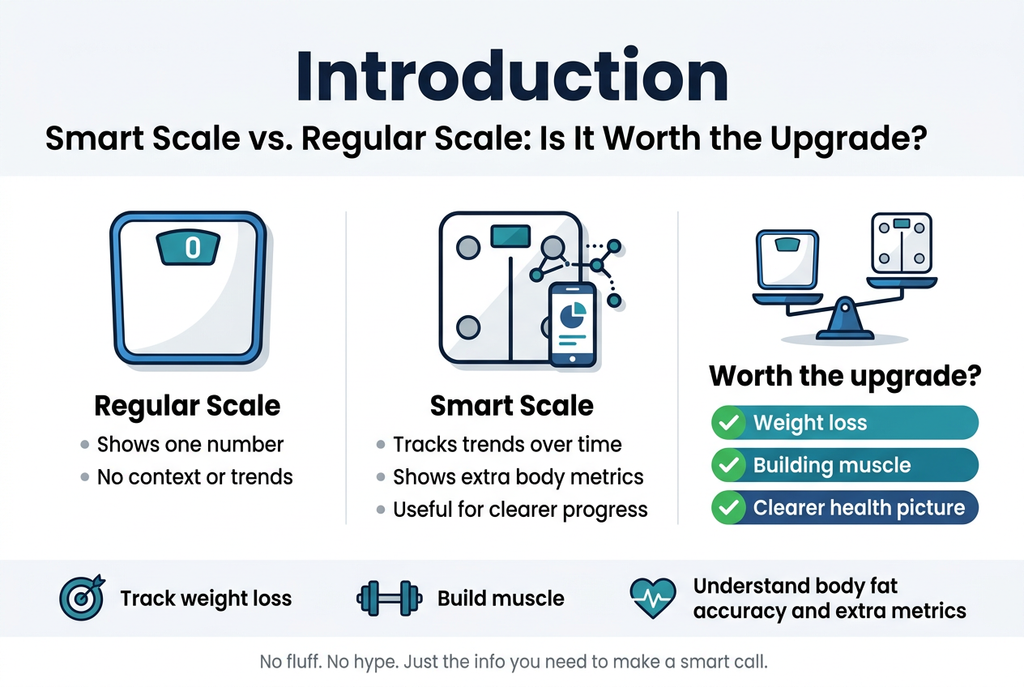
This guide is for anyone tracking weight loss, building muscle, or just trying to get a clearer picture of their health without guessing. I’ll break down the key differences between smart scales and regular scales, talk honestly about body fat scale accuracy and what those extra metrics actually mean for you, and help you figure out if the cost makes sense for your goals.
No fluff, no hype, just the info you need to make a smart call.
Quick Answer: Which Should You Buy?
- Choose a regular scale if you just want a simple, reliable number, you’re on a tight budget, or numbers beyond weight tend to stress you out.
- Choose a smart scale if you like tracking trends, want everything synced to an app, or want to watch body composition changes (not just pounds) over time.
Now let’s dig into the details.
Understanding the Key Differences Between Smart vs Regular Scales
What Is a Regular Scale?
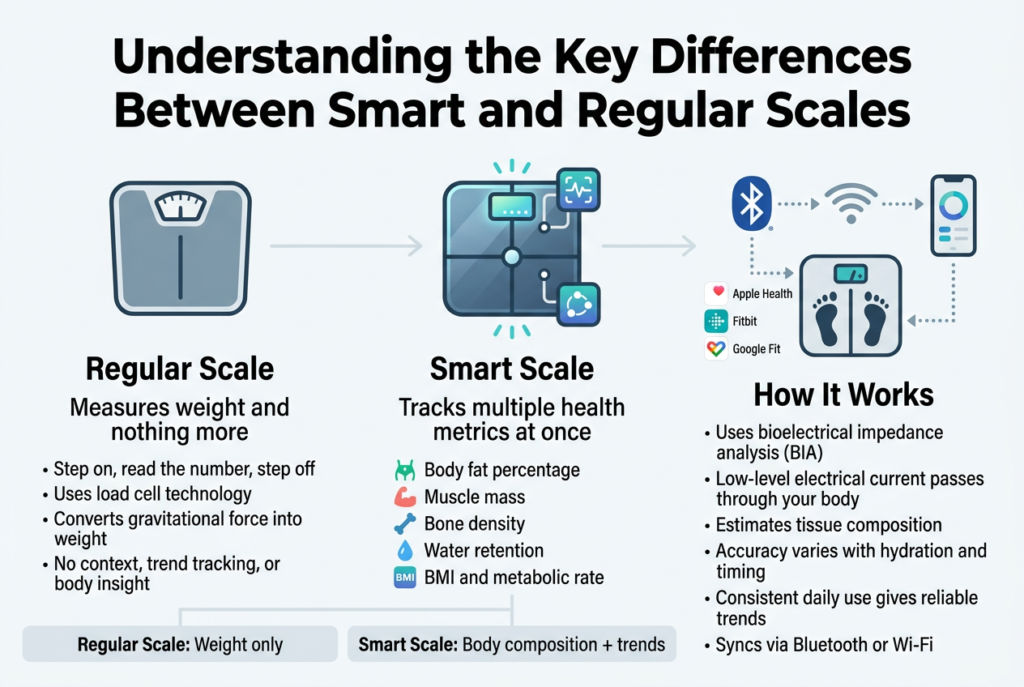
A regular scale does one thing, it tells you how much you weigh. Step on, read the number, step off. That’s the entire experience. It uses simple load cell technology to measure gravitational force and converts that into a weight reading. There’s no context, no trend tracking, and no insight into what’s actually happening inside your body.
Pros
- Inexpensive
- Simple and fast to use
- Nothing to set up or sync
- Fewer distractions from extra numbers
Cons
- Only tells you total weight
- No automatic tracking or history
- You have to log your numbers manually
What Is a Smart Scale?
A smart scale connects to your phone through Bluetooth or Wi-Fi and syncs your measurements to an app. Most models also estimate body composition using a technology called bioelectrical impedance analysis (BIA). The scale sends a very low, harmless electrical signal through your feet and estimates things like:
- Body fat percentage
- Muscle mass
- Body water percentage
- Bone mass
- BMI
- Visceral fat (on some models)
Many also sync with apps like Apple Health, Google Fit, Fitbit, MyFitnessPal, or Samsung Health, and can support multiple user profiles for the whole household.
Pros
- Automatic tracking and trend charts
- Body composition estimates, not just weight
- App integrations with your other health tools
- Multiple user profiles
- Motivating visuals when progress is slow
Cons
- Costs more than a basic scale
- Body composition numbers are estimates, not exact
- Requires setup, an app, and sometimes an account
- Can lead to obsessing over data
Smart Scale vs. Regular Scale: Side-by-Side Comparison
| Feature | Regular Scale | Smart Scale |
|---|---|---|
| Price | Usually lowest | Usually moderate |
| Measures weight | Yes | Yes |
| Body fat and muscle estimates | No | Yes (estimates) |
| App and automatic tracking | No | Yes |
| Syncs with fitness apps | No | Yes |
| Multiple users | Limited | Yes |
| Setup | None | Quick app setup |
| Best for | Simplicity and budget | Trends and body composition |
Are Smart Scales Accurate?
This is the question that matters most, and it deserves a straight answer.
For weight: yes. A quality smart scale is generally just as accurate at measuring weight as a quality regular scale. The sensors that measure weight are similar.
For body fat and muscle: use caution. BIA scales estimate body composition using formulas, and the results can be affected by:
- How hydrated you are
- When you last ate or exercised
- Time of day
- Skin moisture and foot placement
- Menstrual cycle and sodium intake
In other words, the exact body fat percentage on your screen may not match a DEXA scan or a clinical measurement. Where smart scales shine is tracking changes over time. If you weigh under the same conditions each day, the trend can be far more useful than any single reading.
Why This Matters on Keto
Keto has a quirk that makes a basic scale a bit misleading. In the first couple of weeks, many people lose a lot of weight quickly, largely from water and stored glycogen, which isn’t the same as fat loss. After that, the scale can stall even while your body composition is improving.
That’s where a smart scale can help. Seeing body fat and muscle trends alongside weight can provide helpful context when the number on the scale stops moving. Just remember that those composition numbers are estimates, so look at the long-term direction rather than daily swings.
Who Should Buy a Regular Scale?
A basic scale is a smart choice if you:
- Want the simplest, cheapest option
- Only care about your weight
- Find extra metrics confusing or stressful
- Prefer to track in a notebook or on your own
- Are buying a scale for a guest bathroom or a family member who just wants a number
Who Should Buy a Smart Scale?
A smart scale is likely worth it if you:
- Want automatic logging so you never have to write numbers down
- Are tracking keto or weight loss progress and want trend charts
- Strength train or exercise and want to monitor body composition
- Already use apps like Apple Health, Google Fit, or MyFitnessPal
- Share a scale with family members and want separate profiles
- Get motivated by seeing data and graphs
What to Look for When Buying a Smart Scale
Before you click “add to cart,” check these features:
- App quality and reviews. A great scale with a clunky app is frustrating. Read recent reviews about the app experience.
- App compatibility. Make sure it syncs with the health apps you already use.
- Connectivity. Wi-Fi models sync without your phone nearby, while Bluetooth models need your phone close.
- Weight capacity and platform size. Check that it fits your needs and your bathroom space.
- Multiple user profiles. Important if more than one person will use it.
- Data privacy. Some brands require accounts and collect health data. Read the privacy policy.
- Customer reviews on accuracy. Look for consistency, meaning the scale gives repeat readings that match.
5 Best Smart Scales on Amazon
RENPHO Elis 1 Smart Body Fat Scale: A popular entry-level option that tracks weight and provides 13 body metrics through its companion app, including BMI, body fat, muscle mass, and body water.
Pros
- Affordable starting point.
- Multiple measurements and progress charts.
- Compatible with popular health apps.
Cons
- Bluetooth syncing requires a phone nearby.
- Body composition estimates can fluctuate.
Best for: Beginners, budget-conscious buyers, and people starting a weight-loss journey.
Wyze Scale X : The Wyze Scale X tracks 13 body composition metrics and supports baby, pet, and luggage weighing modes. It also offers multi-user sharing and integration with compatible health apps.
Pros
- Tracks weight, body fat, muscle mass, and more.
- Useful extra weighing modes.
- Slim design and long advertised battery life.
Cons
- Many metrics are viewed in the app rather than on the scale.
- Some users may prefer a more detailed health dashboard.
Best for: Households that want affordable tracking for multiple people and everyday wellness goals.
Etekcity Smart Fitness Scale: Etekcity’s Bluetooth smart scale pair with the VeSync app to help users record weight and review body composition estimates.
Pros
- Competitive price.
- App-based progress tracking.
- A practical option for tracking several metrics without a premium price.
Cons
- Bluetooth models depend on phone connectivity.
- Different models have different features and metric counts.
Best for: Readers who want an affordable alternative to RENPHO for routine weight and fitness tracking.
Withings Body Smart: This connected scale combines weight tracking, body composition estimates, and Wi-Fi syncing. It is a good option for readers who want to build a consistent tracking routine with less dependence on their phone at each weigh-in.
Pros
- Wi-Fi and Bluetooth connectivity.
- Detailed weight trends and body composition metrics.
- Supports multiple users.
Cons
- Costs considerably more than entry-level scales.
- A newly introduced Withings subscription policy affects third-party app syncing for new users registered from October 13, 2026. Check current terms before recommending it. The Verge+1
Best for: Readers who value automatic logging and a more polished connected-health experience.
Garmin Index S2 Smart Scale: The Garmin Index S2 tracks weight, BMI, body fat percentage, skeletal muscle mass, and other measurements. Its main advantage is integration with Garmin Connect for people who already use Garmin fitness devices.
Pros
- Integrates with the Garmin ecosystem.
- Wi-Fi connectivity and weight trend tracking.
- Useful for people monitoring multiple fitness metrics.
Cons
- Expensive compared with basic smart scales.
- Less compelling if the reader doesn’t use Garmin products.
Best for: Runners, gym-goers, and fitness enthusiasts already using Garmin watches or activity trackers.
Side-by-side smart scale comparison table
| Smart scale | Metrics beyond weight | Connectivity | Main advantage | Main drawback | Best for |
|---|---|---|---|---|---|
| RENPHO Elis 1 | 13 body metrics | Bluetooth | Affordable and feature-rich | Phone-dependent syncing | Beginners |
| Wyze Scale X | 13 body metrics | Bluetooth | Multiple user and weighing modes | App needed for detailed metrics | Families |
| Etekcity Smart Fitness Scale | Varies by model | Usually Bluetooth | Affordable tracking | Features vary by model | Value shoppers |
| Withings Body Smart | Body composition and additional wellness metrics | Wi-Fi + Bluetooth | Automatic syncing | Higher cost; subscription considerations | Connected-health users |
| Garmin Index S2 | Body composition and weight trends | Wi-Fi | Garmin Connect integration | Premium price | Fitness enthusiast |
Tips for Getting the Most Accurate Readings
Whichever scale you pick, these habits make your data far more reliable:
- Weigh at the same time every day, ideally in the morning after using the bathroom and before eating or drinking.
- Use a hard, flat surface. Carpet can throw off readings.
- Stand barefoot and dry (essential for body composition scales).
- Wear the same clothing, or none at all.
- Focus on weekly trends, not daily numbers. Normal fluctuations of a few pounds are common.
- Don’t move the scale around. Calibrate it again if you do.
The Verdict: Is a Smart Scale Worth It?
For most people on a keto or weight loss journey, a smart scale is worth it if you will actually use the data. The automatic tracking and trend charts remove friction and keep you consistent, and body composition estimates can offer encouragement when the scale stalls.
But if you just want a simple, dependable weight reading, a good regular scale does the job perfectly well and costs less. The best scale is the one you’ll step on consistently.
Remember, a scale is only one tool. Energy levels, how your clothes fit, measurements, strength, and sleep all tell part of the story too.
Is a smart scale worth it for weight loss?
It can be, especially if you benefit from seeing trends and having your data logged automatically. The scale itself doesn’t cause weight loss, but consistent tracking helps many people stay accountable. If you only need your weight, a regular scale works just as well.
Are smart scales accurate?
For weight, quality smart scales are generally accurate. For body fat, muscle mass, and similar metrics, they provide estimates that can vary with hydration and other factors. They are best used to track changes over time rather than as exact measurements.
Can a smart scale measure body fat accurately?
Not with clinical precision. Most use bioelectrical impedance, which is influenced by hydration, meal timing, and exercise. For the most reliable use, weigh under the same conditions every day and watch the trend.
What is the difference between a smart scale and a digital scale?
A digital scale shows your weight on a screen. A smart scale does that too, but also connects to an app and typically estimates body composition metrics. All smart scales are digital, but not all digital scales are smart.
How often should I weigh myself on keto?
Many people weigh daily to track trends, while others prefer once or twice a week to avoid stress over normal fluctuations. Whichever you choose, stay consistent and look at the overall direction. Early keto weight changes often reflect water loss, so be patient.
Why does my weight fluctuate so much?
Daily changes of a few pounds are normal and are usually due to water retention, sodium, digestion, hormones, and activity. This is why weekly averages are more meaningful than any single reading.
Do I need Wi-Fi or a phone for a smart scale?
Bluetooth models need your phone nearby to sync, though many store readings and upload them later. Wi-Fi models sync automatically without your phone. Either way, you’ll need a smartphone to set up and view most data.
Are smart scales safe to use?
For most people, yes. The electrical signal used is extremely low and not felt. However, manufacturers generally advise people with pacemakers or other implanted electronic medical devices, and pregnant women, to avoid body composition scales. Check the product instructions and talk to your doctor if you’re unsure.
Where should I put my scale?
Place it on a hard, flat surface, such as tile or hardwood, and keep it in the same spot. Soft surfaces like carpet or bath mats can distort results.
Who Benefits Most from Upgrading to a Smart Scale
Fitness Enthusiasts Looking to Optimize Their Training
If you’re serious about your training, a smart scale gives you data that actually moves the needle. Tracking muscle mass, body fat percentage, and hydration levels helps you see whether your program is building the right kind of progress — not just lighter numbers on the scale.
People Managing Weight Loss or Chronic Health Conditions
When you’re working toward a health goal, whether that’s weight loss or managing something like diabetes or hypertension, body composition data matters far more than weight alone. The best smart scale for weight loss tracks trends over time, giving you and your doctor a clearer picture of what’s really changing.
Families Who Want One Device to Track Multiple Users
Most smart scales support multiple profiles, so your whole household can track their individual metrics without sharing data. Each person gets their own dashboard, history, and goals, one device, zero confusion.
Casual Users Who Simply Want Basic Weight Monitoring
Here’s the honest truth: if you only want your weight, a regular scale does that job just fine. In the smart scale vs. regular scale debate, casual users get the least return on investment. You’d be paying extra for features you’ll likely ignore within the first few weeks.
Final Thoughts
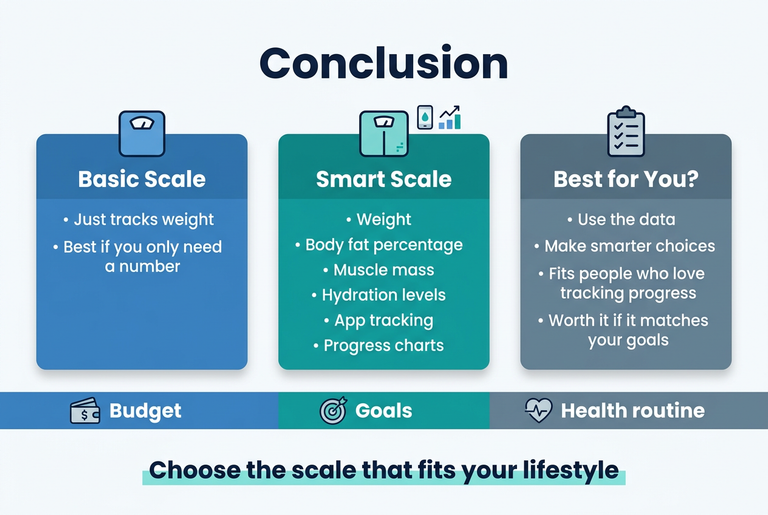
Choosing between a smart scale and a regular scale really comes down to what you want to get out of your health journey. If you just need a number to track your weight, a basic scale does the job just fine. But if you want deeper insights like body fat percentage, muscle mass, and hydration levels, plus the added push of app tracking and progress charts, a smart scale brings a lot more to the table. The extra data can make a real difference in how you understand your body and stay on top of your goals.
That said, a smart scale is not a magic fix. It works best when you actually engage with the data it gives you and use it to make smarter choices. If you are someone who loves tracking progress and wants more than just a number, the upgrade is likely worth every penny. Take a look at your budget, your goals, and how you approach your health routine, then decide which scale truly fits your lifestyle.
And if you’re just starting out on your keto journey, be sure to check out my other guides on:
- Best Keto Coffee Creamers
- Best Air Fryers for Keto Cooking
- 25 Easy Low Carb Recipes for Busy Nights
- Best Keto Snacks on Amazon for Fast Weight Loss
- Best Keto Kitchen Tools for Easy Meal Prep
Have a question about choosing a scale? Leave it in the comments and I’ll help you out.
Health note: This content is for informational purposes only and is not a substitute for professional medical advice. Always consult your doctor before starting a new diet or weight loss program.